
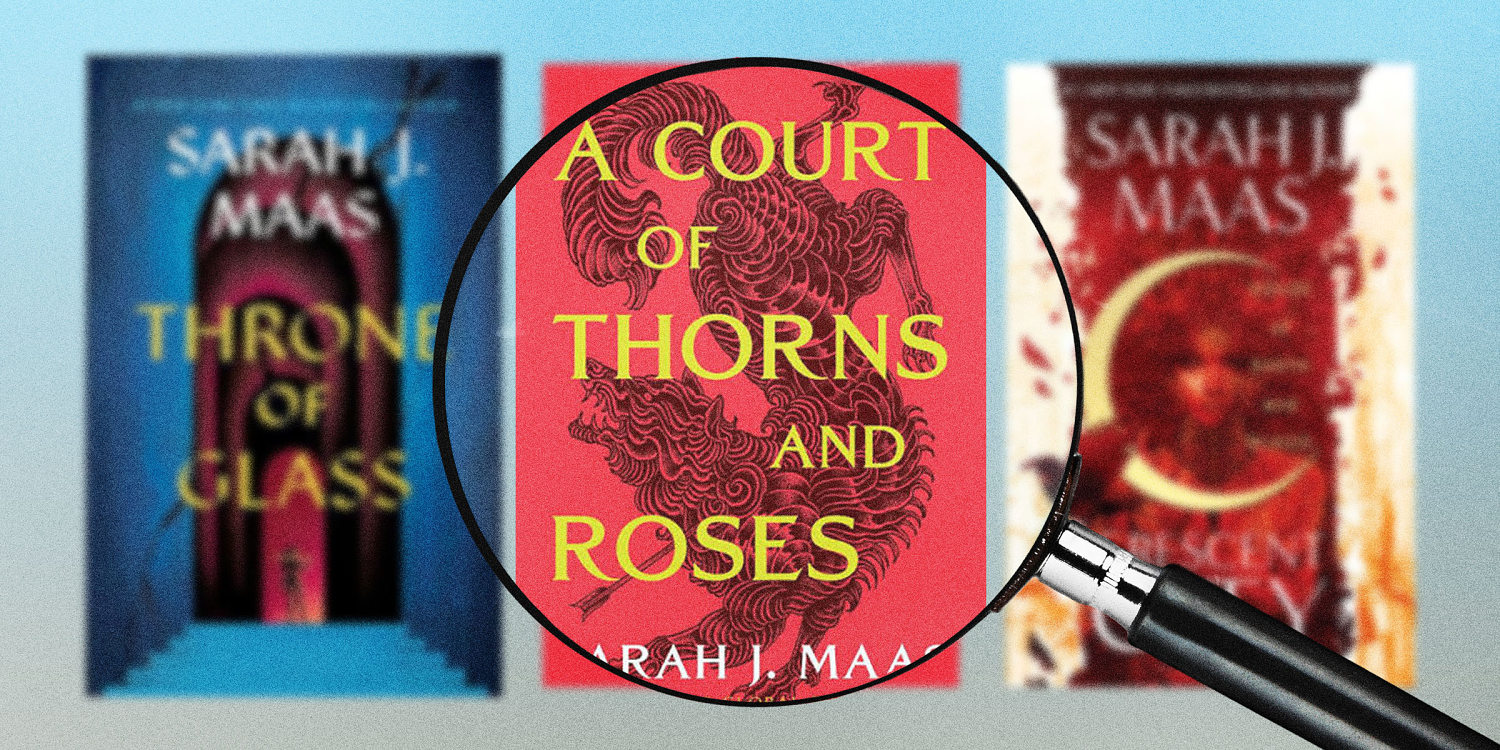
🚨 Spoilers ahead for Sarah J. Maas’ book series “Throne of Glass,” “A Court of Thorns and Roses” and “Crescent City.”
Before Sarah J. Maas releases the next novel in her “A Court of Thorns and Roses” series, many readers are revisiting the last story in which those characters appeared.
The only tricky element? That story was not a “Court of Thorns and Roses” book.
“A Court of Silver Flames” from 2021 is indeed the most recent book published in the “ACOTAR” series, but — and here comes the spoiler — some of those characters were last seen on the page in another series written by Maas: “Crescent City’s” third book from 2024, “House of Flame and Shadow.” That 850-page behemoth was the first to give a fuller scope at how all three of Maas’ fantasy series — “ACOTAR,” “Crescent City” and “Throne of Glass” — intertwine in one larger universe.
Here’s a deep dive into all the Easter eggs, callbacks and references that connect the three book series, ranging from the cryptic to the overt.
How ‘ACOTAR’ and ‘Throne of Glass’ Connect
The first explicit crossover between Maas’ series came in 2018, with the “Throne of Glass” finale, “Kingdom of Ash.”
As Aelin falls between worlds at the peak of her battle with the Valg, she passes through a “world of snowcapped mountains under shining stars” and sees two Fae: one winged male and one “heavily pregnant female.” The male notices her falling and sends his power, “like a gentle summer night,” to slow her down. This is Rhysand and Feyre, likely during the events of “A Court of Silver Flames,” which lines up with her pregnancy.
When “A Court of Silver Flames” published in 2021, some readers believed that moment was seen from the other perspective. In Chapter 62, after the annual Starfall event, a “rare red star” is spotted blasting across the sky and is interpreted as an “ill omen.”
How ‘ACOTAR’ and ‘Crescent City’ Connect
“Crescent City” more clearly establishes that the worlds of Maas’ three series are interconnected, starting with last line of the last chapter in Book 2, “House of Sky and Breath.”
Bryce Lands in Prythian
At the end of “Crescent City” 2, heroine Bryce Quinlan confronts the Asteri, the rulers of her planet, Midgard. She learns they are not benevolent leaders but parasites who survive on firstlight generated by magical beings. When she learns the truth, she tries to use the Horn, which can open rifts between worlds, to go to Hel for help against the Asteri.
Instead she lands in another world, surrounded by Fae who believe her to be a threat. One of them looks eerily similar to her brother, Ruhn. When Bryce says her name, that Fae male responds: “Hello, Bryce Quinlan. My name is Rhysand.”
And there ends Book 2.
The Asteri Came From Prythian
Book 3, “House of Flame and Shadow,” picks up where Book 2 leaves off. When Bryce lands in Prythian, Rhys and his Inner Circle interrogate Bryce. Soon they all learn that the Asteri, the primary villains in “Crescent City,” are the same as the Daglan, an evil force found in the history books of Prythian.
Readers learn in “A Court of Silver Flames” that the Daglan were vanquished by Rhys’ ancestors 15,000 years before the events of the books. But in “House of Flame and Shadow,” Bryce discovers that the Daglan escaped to Midgard to conquer a new planet and curate sources of power to serve as food. But they have maintained a desire to find a way back to their home world.
The Horn Is Part of the Dread Trove
The ancient Fae relic known as the Horn is a big part of “Crescent City” lore. It’s first introduced in “House of Earth and Blood” when it goes missing from its place in Luna’s Temple. By the end of the book, readers learn Bryce’s best friend, Danika, had discovered the Horn’s ability to open doors between worlds, ground it into ashes, mixed it with ink and imbued it onto Bryce’s back as a tattoo when she was drunk. This was Danika’s effort to hide the Horn from the evil people looking for it and happened days before she was killed.
While Bryce is in Prythian in “House of Flame and Shadow,” she learns that the Horn is actually part of the Dread Trove, a collection of powerful artifacts made by the Cauldron. In a “Court of Silver Flames,” Nesta and the Night Court find the other three relics in the Trove — the Harp, the Crown and the Mask.
And speaking of missing artifacts — Bryce and the Night Court crew also learn in “House of Flame and Shadow” that Gwydion, a long-missing sword that’s a pair to spymaster Azriel’s dagger Truth-Teller, is none other than Bryce’s Starsword, a weapon in Midgard that can only be wielded by the chosen Starborn Fae.
The Book of Breathings
In “House of Flame and Shadow,” Bryce at first tries to hide from the Night Court crew her tattoo that contains the Horn. The tattoo is written in a script Bryce doesn’t even know and is supposed to translate to, “Through love, all is possible.”
Amren is first to clock the tattoo and tells Rhys that Bryce’s tattoo is written in the same language found in “The Book of Breathings,” an object in the “ACOTAR” world with an ability to control the Cauldron. The book is also mysteriously mentioned in “House of Earth and Blood”; it’s in Jesiba Roga’s library alongside “The Walking Dead,” a book from “Throne of Glass.”
In “A Court of Mist and Fury,” Amren identifies the language in which “The Book of Breathings” is written as “Leshon Kadoesh” or “The Holy Tongue.” Rhys then shares that, according to legend, the language is one “of mighty beings who were here … and then vanished.”
The Middengard Wyrm
In “House of Flame and Shadow,” Bryce teams up with Nesta and Azriel to navigate a tunnel system near the Prison, led by the light from the glowing eight-pointed star on Bryce’s chest. One of the obstacles they face is the Middengard Wyrm, a large-toothed monster that Feyre faces in the first “ACOTAR” book.
But Bryce raises an interesting question when facing the creature.
“Middengard? Like — Midgard? Did they come from my world originally?” she asks, though Nesta and Azriel are unable to answer.
The Dusk Court
The theory of a lost Dusk Court was popular among “ACOTAR” fans, since it felt like a glaring omission from Prythian’s landscape. The continent has four seasonal courts — Spring, Autumn, Summer and Winter — and three solar courts — Night, Day and Dawn, but no Dusk.
It turns, it did once exist.
In “House of Flame and Shadow,” Bryce, Azriel and Nesta end up in the Prison via the tunnel system and find the same spot Nesta had found the Harp in “A Court of Silver Flames.” (The Harp was notably found on top of a “large rendering of an eight-pointed star.”) (Notably, Nesta has an eight-pointed star on her spine, and Bryce has one that glows on her chest.) (Also notably, a High Priestess in “Throne of Glass” has an eight-pointed star tattooed on her forehead.)
The three then encounter a hologram of Silene, the long lost daughter of Theia, a Fae queen and the original Starborn. Though Bryce already knew she is a descendent of Theia, Silene’s storytelling is how she learns that the Starborn Fae of Midgard had originated in Prythian.
According to Silene, Theia had served the Daglan for a long time while in Prythian, but eventually overthrew them and was able to claim her land — the island on which the Prison is located — for herself. That land thrived with “dusk, twilight — that’s what the island was in its long-buried heart.”
But after getting greedy for power, Theia and her court — as well as people with red hair who “looked alarmingly like Bryce’s father,” the Autumn King — migrated to Midgard, only to find themselves trapped under the reign of the very creatures they had fought to overthrow.
Silene was able to return to Prythian and escape the Asteri, but she concealed her power and the memory of ancestors vanished. The land of the former Dusk Court around her died, forming the barren isolation of the Prison. When Silene eventually married her mate, a High Lord of the Night Court, her firstborn son glowed with starlight inherited from her. “It was light of the evening star. The dusk star,” she says.
Bryce’s Starborn power is later described as a “dusk power,” a force the princes of Hel also call “starfire.”
How ‘Crescent City’ Connects to ‘Throne of Glass’
“House of Flame and Shadow” contains notable crossovers with “Throne of Glass,” Maas’ first series published in 2012. But many speculate that the world of “Crescent City” was first alluded to in “Kingdom of Ash,” the last book in the “Throne of Glass” series.
When Aelin falls between worlds — in the same instance she passes by Rhys and Feyre, as mentioned above — she also passes by a “world where a great city had been built along the curve of a river, the buildings impossibly tall and glimmering with lights.” It’s likely this is Lunathion, aka the titular Crescent City, which gets its name from the bend of the Istros River through it.
From there, though, most connections are seen in passing references and winks at the series.
Wyrd
The most overt connection between “Crescent City” and “Throne of Glass” comes in “House of Flame and Shadow” with the Under-King’s passing reference to Wyrd, which he describes as his home planet’s equivalent of Midgard’s Urd, the goddess of fate.
Wyrd, however, isn’t a goddess, but a “force that governed worlds. A cauldron of life, brimming with the language of creation,” says Under-King, the head of Lunathion’s Bone Quarter and leader of the House of Flame and Shadow.
In “Throne of Glass,” Wyrd, pronounced “word,” is indeed everywhere. The central conflict across the eight-book series centers on Aelin’s attempts to close the Wyrdgates, essentially portals between worlds (sound familiar?) by gathering all the Wyrdkeys. Her goal is to destroy the keys to prevent the Valg, demons that possess people and feed off their souls (again, sound familiar?), from coming to her world and conquering it with the power of Wyrdstone. She also learns to harness the power of Wyrdmarks, aka, magic runes.
It’s unclear if the Valg of “Throne of Glass” are the same as the Asteri/Dalgan, though both beings aim to conquer and consume. But “House of Flame and Shadow” does contain several references to the Asteri’s power over worlds as a “collar,” which is a major tool the Valg used to possess people, like Dorian.
Ithan’s Discovery of An ‘Elemental’ Power
After “House of Sky and Breath,” readers learned that shifters, including wolves like Ithan and Danika, are also Fae who just originated from a different world.
Once Ithan takes Hypaxia’s antidote to the Asteri’s power blocker in “House of Flame and Shadow,” he learns that his power wasn’t always just limited to shifting. He also has the power of wielding snow and ice.
The combination of an animal form and an elemental power is the prototype of the Fae found in “Throne of Glass,” suggesting shifters like Ithan came from the same world as Aelin. Fans of that series will remember Rowan Whitethorn could shift into a hawk and could wield wind.
Let’s also go back to the tale told by Silene, the daughter Queen Theia. When recounting to Bryce, Nesta and Azriel how Theia led a takeover of Midgard, she notes that the rifts opened once again and more Fae appeared “from another world this time.”
“They were Fae like us, but not,” Silene says. “The ears, the grace, the strength were identical, but they were shape-shifters, all of them. Each capable of turning into an animal. And each, even in their humanoid body, equipped with elongated canine teeth.”
The Rise and Fall of the Under-King
Ithan, armed with his newly discovered powers, later takes on the Under-King directly.
The Under-King reveals that he, too, came from the same world as the shifters, the world of “Throne of Glass.” Before Midgard, he was confined to “caves and barrows,” he says.
After the Under-King interrupts Ithan’s final meeting with Connor, the wolf’s rage is heightened by his new Fae powers, and his blood “sings” that the creature is an “enemy.”
“It spoke of caves beneath hills, of plundered graves and musty darkness. Enemy,” Ithan thinks, before destroying the Under-King with the help of Hypaxia.
The Under-King is likely related to a barrow-wight from “Heir of Fire,” the third “Throne of Glass” book. A barrow-wight is a creature that infests tombs, coveting treasure. Aelin faces them while training with Rowan in Mistward.
Lidia’s Heritage
Lidia Cervos, aka the Hind, undergoes a 360-degree transformation from the first “Crescent City” book to the third. The ruthless deer shifter turns out to be a rebel, a mom and mate to Ruhn.
As a shifter, she comes from the world of “Throne of Glass,” like Ithan. But the connection doesn’t stop there. Lidia turns out to have fire in her veins from an “old bloodline” on her father’s side — and that fire becomes “a song in her blood” in the fight against the Asteri.
She explains that the fire comes from her family’s legend of Brannon, “a Fae King from another world, fire in his veins, who had created stags with the power of flame to be his sacred guards.” It’s why she named her son Brannon, Brann for short.
Lidia is likely a descendant of Brannon Galathynius, a major player in the lore of “Throne of Glass.” Brannon is the founder of Terrasen and an ancestor of Aelin Galathynius, who also has the power of fire.
Another potential connection to Aelin is more subtle — Lidia’s ruby ring. Lidia eventually gives this ring to her sons, dismissing it as “an heirloom of my father’s household. He’s not anyone worth remembering.”
But that ring might be one Aelin and Rowan discover in “Kingdom of Ash” from a barrow-wight’s mound of pilfered treasure. Among the gold, they find a pair of rings, one an “elegantly cut ruby within the band itself,” and the other, “a sparkling rectangular emerald.” The pair exchange the rings, Aelin receiving the emerald and Rowan the ruby, in a impromptu ceremony, vowing they’ll stay together “to whatever end.”
Other subtle connections to Aelin and Terrasen, her kingdom in “Throne of Glass,” include the constant stag imagery through the Fae kingdom of Avallen. Terrasen is known as the home of the sun stags, put there by Brannon, and the land is blessed the Lord of the North, a great stag with flaming antlers. Similarly, Avallen’s leader, Morven, is described as the Stag King, with a throne made “from the bones of some noble, butchered beast.”
But the most overt reference that many Maas fans pointed to when the name of the third “Crescent City” book was announced did not come to fruition. Aelin, who is referred to, among many titles, as the Queen of Flame and Shadow once in the “Throne of Glass” series, does not make an appearance in “House of Flame and Shadow.”
Hypaxia, the witch-queen, takes the Under-King’s place as the leader of the shadowy faction by the end of the book. However, she is always referred to as the Head of the House of Flame and Shadow — never the queen.


