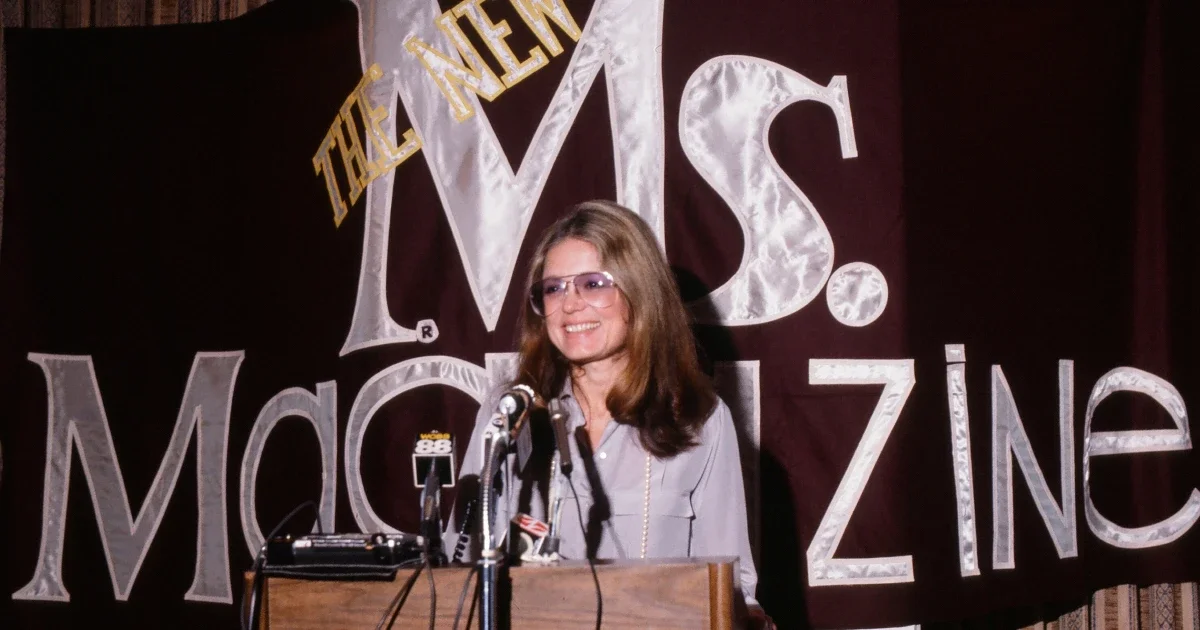
As the world honors trailblazing feminist, journalist and activist Gloria Steinem, who died this week, the groundbreaking magazine she founded more than a half century ago has paid tribute to the icon.
Ms. magazine, which Steinem launched in the 1970s as an answer to a media landscape that largely catered to male interests and relegated women to lifestyle issues, published a moving obituary about the revolutionary founder. It comes hours after it was announced that Steinem had died Sept. 2 in her New York City home, according to a post on her official Instagram page. She was 92.

In the obituary, executive editor Kathy Spillar wrote about the ways in which Steinem “transformed journalism, feminism and the possibilities women could imagine for themselves.”
“For more than half a century, the public knew her as one of feminism’s most recognizable figures: the writer with the center-parted hair and aviator glasses; the assured speaker at rallies, campuses and conventions; the tireless traveler who carried the movement’s ideas into living rooms and union halls, onto television screens and into the corridors of political power,” Spillar wrote in the tribute published Sept. 3. “But Steinem understood something the culture surrounding her often did not: Movements are never made by one person.”
Steinem “passed away peacefully at her home in New York City, surrounded by some of the many who loved her,” according to the Instagram post on her official page. The post did not give a cause of death.
Her women-run magazine, which released its first standalone issue in 1972, continues to publish in print as well as digitally. And much like it did at its inception, the outlet covers stories ranging from women’s health, democracy and culture.
Spillar, who helms the publication, wrote in the tribute that Steinem, who tirelessly championed causes ranging from reproductive rights to eradicating workplace inequalities, fought to elevate intersectionality in the women’s movement.
“She insisted that feminism’s history include the Black women, labor organizers, Indigenous women, lesbians, civil rights leaders and community activists whose work had too often been erased,” Spillar wrote, adding that Steinem often credited figures of all backgrounds — including Shirley Chisolm, the first Black woman to be elected to the United States Congress and civil rights leader and voting rights activist Fannie Lou Hamer — as influences and teachers.
Spillar added that when “the media attempted to anoint her the leader of a leaderless movement, she redirected attention toward the organizers, coalitions and collective action that made change possible.”

Steinem first rose to national prominence in 1963 after going undercover as a Playboy bunny and producing a two-part exposé on the working conditions and treatment of women at the infamous New York Playboy Club.
“The investigation made her famous, but it also temporarily made editors less willing to take her seriously,” Spillar wrote. “That experience taught Steinem a lasting lesson about who determines which stories count as news, and about the cost women pay when men control the institutions that assign, edit, finance and distribute those stories.”
In 1971, Steinem started Ms. as an insert in New York Magazine. At the time, the media environment was heavily skewed toward male consumers, Steinem said, and that there were “no other magazines for women that weren’t about food, fashion and family.”
“I believed that advertisers would soon realize that women’s interests were just as wide and deep as men’s interests are and there would be new magazines that were at least like, say, Esquire for women,” she wrote in a 2023 book about the magazine in celebration of its 50th anniversary.
The insert found almost instant success and sold 300,000 copies in under one week. It contained rarely covered topics from domestic violence to abortion. The groundbreaking preview also included a list of women, including Steinem herself, who admitted to having abortions before they were federally legalized through 1973’s Roe v. Wade decision. The list featured names from Anaïs Nin to Billie Jean King.
The preview itself was highly controversial. CBS “60 Minutes” host Harry Reasoner, for example, famously said, “I’ll give it six months before they run out of things to say.” Years later, Reasoner apologized for the remark. Syndicated columnist James Kilpatrick called the work a note of “petulance, of bitchiness, or nervous fingernails screeching across a blackboard.”
By the next year, Steinem’s publication released its first standalone issue. The cover featured superhero Wonder Woman with the headline “Wonder Woman for President,” in part a commentary on DC Comics’ decision to remove the character’s superpowers. An essay about Wonder Woman’s feminist impact in the issue prompted the comic book giant to restore her powers.
As years went by, the magazine became a major vehicle for the second wave of feminism, of which many saw Steinem as one of the faces. In contrast to the earlier wave, this newer movement expanded the push for equality to a broader range of issues in society from employment to politics to sexuality.
Today, the outlet stands as “an independent, nonprofit feminist,” Spillar wrote.
“Ms. is not owned by a billionaire or beholden to commercial advertisers. It is an independent, nonprofit feminist newsroom sustained by Ms. partners, readers and donors,” Spillar wrote. “That model allows us to investigate stories advertisers may find inconvenient, to center people commercial media consider insufficiently profitable and to report on women not as a demographic niche but as full human beings whose freedom is inseparable from democracy.”
Spillar called on readers to support independent media, an indelible part of Steinem’s legacy.
“The most important monument to Gloria will not be a statue, an award or even a shelf of remarkable books. It will be the work we— working together — do next,” Spillar wrote. “It will be every person who organizes instead of surrendering to isolation. Every journalist who asks whose voice is missing. Every reader who supports independent media. Every young person who discovers that an injustice bearing down on their life is neither natural nor inevitable. That’s how the circle grows wider.”
She concluded, writing that Steinem “changed the story women were permitted to tell about themselves.
“Now it is our responsibility to keep telling the truth — and to make certain that no billionaire, advertiser, government or algorithm can silence it,” Spillar wrote.


