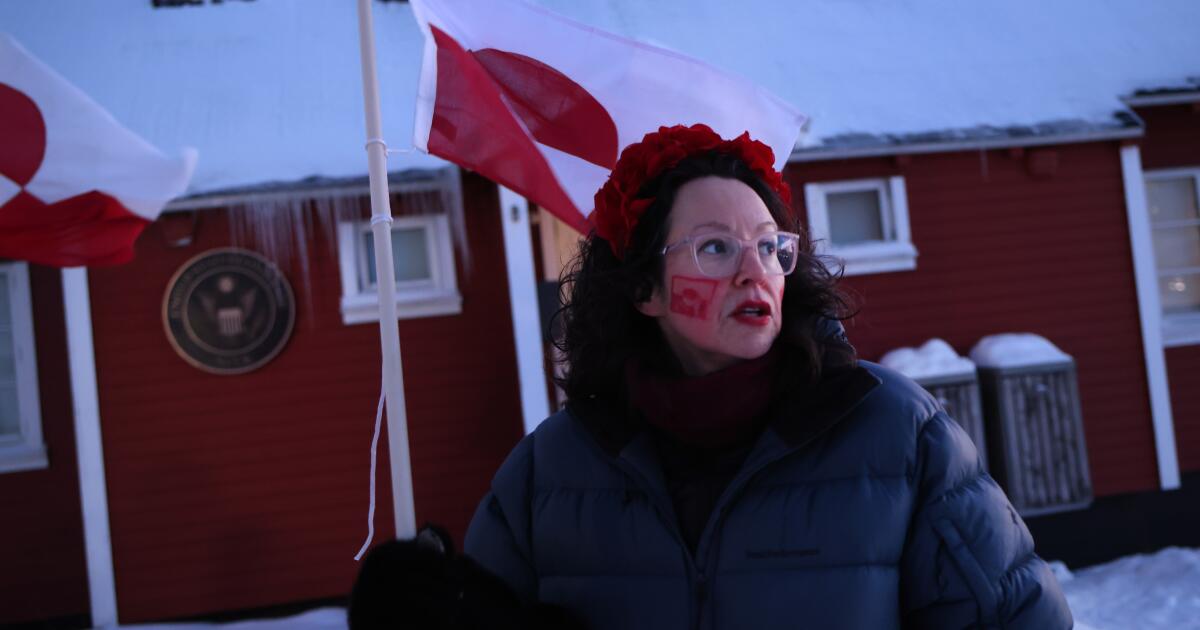
NUUK, Greenland — President Trump retreated Wednesday from his most serious threats toward Denmark, easing transatlantic tensions and lifting Wall Street after rejecting the prospect he would use military force to annex Greenland, a Danish territory and the world’s largest island.
Instead, the United States struck a “framework” agreement in talks with NATO’s secretary general regarding the future of Greenland, “and in fact, the whole Arctic region,” Trump wrote on social media. He did not immediately provide details on the contents of the plan.
The whiplash of developments followed weeks of escalating threats from the president to control Greenland by any means necessary — including by force, if left with no other choice.
Now, “the military’s not on the table,” Trump told reporters at the economic forum in Switzerland, acknowledging sighs of relief throughout the room.
“I don’t think it will be necessary,” he said. “I really don’t. I think people are going to use better judgment.”
It was a turn of events that came as welcome news in Nuuk, where signs hang in storefronts and kitchen windows rejecting American imperialism.
“It’s difficult to say what are negotiating tactics, and what the foundation is for him saying all of this,” said Finn Meinel, an attorney born and raised in the Greenlandic capital. “It could be that joint pressure from the EU and NATO countries has made an impact, as well as the economic numbers in the states. Maybe that has had an influence.”

President Trump speaks during the World Economic Forum in Davos, Switzerland on Wednesday.
(Evan Vucci / Associated Press)
In his speech at Davos, Trump took note of the market turmoil his threats against Greenland had caused entering the conference. Announcing the agreement framework on social media Wednesday, he said he would pause punitive tariffs planned against longstanding European allies that had refused to support his demands.
Prominent world leaders — including from Canada, France and the United Kingdom, among Washington’s closest allies — had warned earlier this week that Trump’s militant threats against a fellow NATO member were ushering in a new era of global order accommodating a less reliable United States.
For years, Trump has called for U.S. ownership over Greenland due to its strategic position in the Arctic Circle, where ice melting due to climate change is making way for a new era of competition with Russia and China. An Arctic conflict, the president says, will require a robust U.S. presence there.
While the president rejects climate change and its perils as a hoax, he has embraced the opportunities that may come with the melting of Greenland’s ice sheet, the world’s largest after Antarctica, including the opening of new shipping lanes and defense positions.
The United States already enjoys broad freedom to deploy any defense assets it sees fit across the island, raising questions in Europe over Trump’s fixation on outright sovereignty over the land.
“We want a piece of ice for world protection, and they won’t give it. We’ve never asked for anything else,” Trump said, addressing members of the NATO alliance.
“I don’t want to use force. I won’t use force,” Trump said. But Europe still has a choice. “You can say yes, and we will be very appreciative,” he continued, “or you can say no, and we will remember.”

-
Share via
The day before Trump’s speech, allies warned about a “rupture” in a global order in which the United States could be relied upon as a force of good. Canada’s prime minister, Mark Carney, in a speech Tuesday characterized Trump’s push to acquire Greenland as an example of why “the old order is not coming back.”
Trump apparently took note of Carney’s remarks, and told the crowd on Wednesday that Canada “should be grateful.”
“But they are not,” Trump said. “Canada lives because of the United States. Remember that, Mark, the next time you make your statements.”
The president struck a similar tone with his demands for Greenland, repeatedly characterizing the United States as a “great power” compared with Denmark in its ability to protect the Arctic territory. At one point, he cited the American military’s role in World War II to justify his demands, telling the eastern Swiss audience that, “without us, you’d all be speaking German, or a little Japanese perhaps.”
It was a slight carried forward by the president’s treasury secretary, Scott Bessent, who derided Copenhagen for its decision to divest from U.S. treasuries. “Denmark’s investment in U.S. treasury bonds like Denmark itself is irrelevant,” the secretary said.
In several instances, Trump framed the transatlantic alliance as one that benefits other countries more than the United States.
“We will be with NATO 100%, but I’m not sure they will be there for us,” Trump said. But NATO Secretary Gen. Mark Rutte responded to the concern in their meeting, noting that the alliance’s Article 5 commitment to joint defense has only been invoked once — by the United States, after the September 11th attacks. “Let me tell you: they will,” Rutte said.
But Trump expanded on his thinking over Greenland in his speech to the summit, describing his fixation on Greenland as “psychological,” and questioning why the United States would come to the island’s defense if its only investment was a licensing agreement.
“There’s no sign of Denmark there. And I say that with great respect for Denmark, whose people I love, whose leaders are very good,” Trump said. “It’s the United States alone that can protect this giant, massive land – this giant piece of ice – develop it, and improve it, and make it so that it’s good for Europe, and safe for Europe, and good for us.”
California Gov. Gavin Newsom was among the people in the audience reacting to Trump’s remarks in real time. The president’s speech, he told CNN afterward, was “remarkably boring” and “remarkably insignificant.”
“He was never going invade Greenland. It was never real,” Newsom said. “That was always a fake.”
Wilner reported from Nuuk, Ceballos from Washington, D.C.


