CARACAS, Venezuela — It was about 2 a.m. Saturday Caracas time when the detonations began, lighting up the sullen sky like a post-New Year’s fireworks display.
“¡Ya comenzó!” was the recurrent phrase in homes, telephone conversations and social media chats as the latest iteration of U.S. “shock and awe” rocked the Venezuelan capital. “It has begun!”
Then the question: “¿Maduro?”
The great uncertainty was the whereabouts of President Nicolás Maduro, who has been under Trump administration threat for months.
The scenes of revelry from a joyous Venezuelan diaspora celebrating from Miami to Madrid were not repeated here. Fear of the unknown kept most at home.
Hours would pass before news reports from outside Venezuela confirmed that U.S. forces had captured Maduro and placed him on a U.S. ship to face criminal charges in federal court in New York.
Venezuelans had watched the unfolding spectacle from their homes, using social media to exchange images of explosions and the sounds of bombardment. This moment, it was clear, was ushering in a new era of uncertainly for Venezuela, a nation reeling from a decade of economic, political and social unrest.

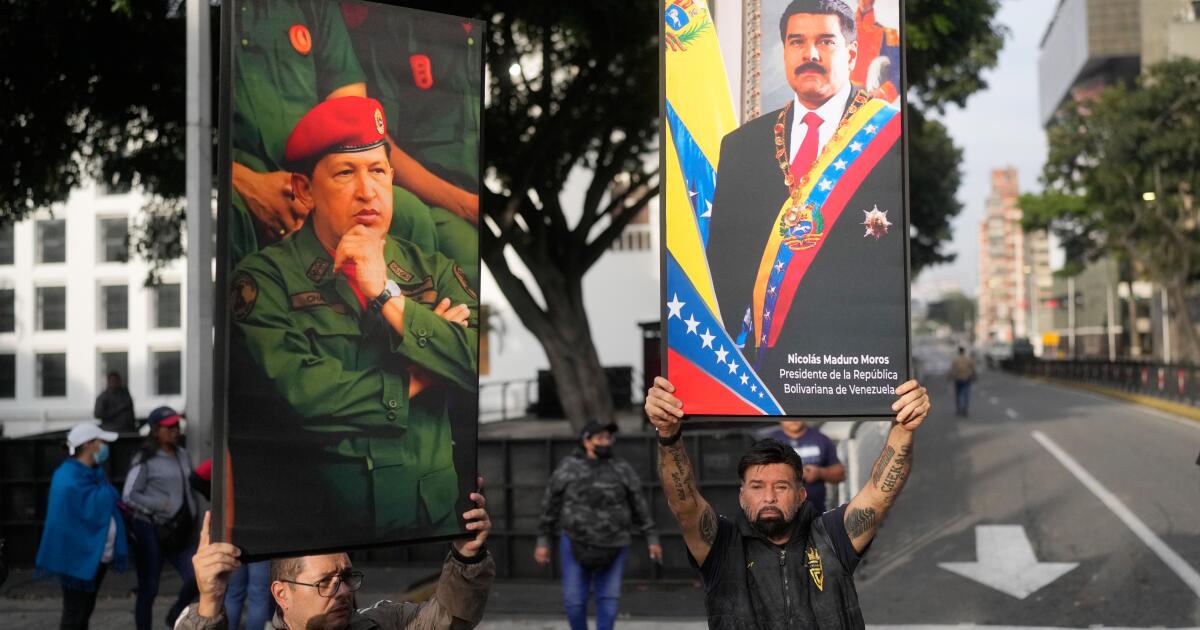
Government supporters display posters of Venezuelan President Nicolás Maduro, right, and former President Hugo Chávez in downtown Caracas on Saturday.
(Matias Delacroix / Associated Press)
The ultimate result was an imponderable. But that this was a transformative moment — for good or bad — seemed indisputable.
By daybreak, an uneasy calm overtook the city of more than 3 million. The explosions and the drone of U.S. aircraft ceased. Blackouts cut electricity to parts of the capital.
Pro-government youths wielding automatic rifles set up roadblocks or sped through the streets on motorcycles, a warning to those who might celebrate Maduro’s downfall.
Shops, gas stations and other businesses were mostly closed. There was little traffic.
“When I heard the explosions, I grabbed my rosary and began to pray,” said Carolina Méndez, 50, who was among the few who ventured out Saturday, seeking medicines at a pharmacy, though no personnel had arrived to attend to clients waiting on line. “I’m very scared now. That’s why I came to buy what I need.”
A sense of alarm was ubiquitous.

Motorcycles and cars line up for gas Saturday in Caracas. Most of the population stayed indoors, reluctant to leave their homes except for gas and food.
(Andrea Hernandez Briceno / For The Times)
“People are buying bottled water, milk and eggs,” said Luz Pérez, a guard at one of the few open shops, not far from La Carlota airport, one of the sites targeted by U.S. strikes. “I heard the explosions. It was very scary. But the owner decided to open anyway to help people.”
Customers were being allowed to enter three at a time. Most didn’t want to speak. Their priority was to stock up on basics and get home safely.
Rumors circulated rapidly that U.S. forces had whisked away Maduro and his wife, Cilia Flores.
There was no immediate official confirmation here of the detention of Maduro and Flores, both wanted in the United States for drug-trafficking charges — allegations that Maduro has denounced as U.S. propaganda. But then images of an apparently captive Maduro, blindfolded, in a sweatsuit soon circulated on social media.
There was no official estimate of Venezuelan casualties in the U.S. raid.
Rumors circulated indicating that a number of top Maduro aides had been killed, among them Diosdado Cabello, the security minister who is a staunch Maduro ally. Cabello is often the face of the government.
But Cabello soon appeared on official TV denouncing “the terrorist attack against our people,” adding: “Let no one facilitate the moves of the enemy invader.”
Although Trump, in his Saturday news conference, confidently predicted that the United States would “run” Venezuela, apparently during some undefined transitional period, it’s not clear how that will be accomplished.
A key question is whether the military — long a Maduro ally — will remain loyal now that he is in U.S. custody. There was no public indication Saturday of mass defections from the Venezuelan armed forces. Nor was it clear that Maduro’s government infrastructure had lost control of the country. Official media reported declarations of loyalty from pro-government politicians and citizens from throughout Venezuela.

A billboard with an image of President Nicolas Maduro stands next to La Carlota military base in Caracas, Venezuela, on Saturday. The graffiti reads, “Fraud, fraud.”
(Andrea Hernandez Briceno / For The Times)
In his comments, Trump spoke of a limited U.S. troop presence in Venezuela, focused mostly on protecting the oil infrastructure that his administration says was stolen from the United States — a characterization widely rejected here, even among Maduro’s critics. But Trump offered few details on sending in U.S. personnel to facilitate what could be a tumultuous transition.
Meantime, Venezuelan Vice President Delcy Rodríguez surfaced on official television and demanded the immediate release of Maduro and his wife, according to the official Telesur broadcast outlet. Her comments seemed to be the first official acknowledgment that Maduro had been taken.
“There is one president of this country, and his name is Nicolás Maduro,” the vice president said in an address from Miraflores Palace, from where Maduro and his wife had been seized hours earlier.
During an emergency meeting of the National Defense Council, Telesur reported, Rodríguez labeled the couple’s detention an “illegal kidnapping.”
The Trump administration, the vice president charged, meant to “capture our energy, mineral and [other] natural resources.”
Her defiant words came after Trump, in his news conference, said that Rodríguez had been sworn in as the country’s interim president and had evinced a willingness to cooperate with Washington.
“She’s essentially willing to do what we think is necessary to make Venezuela great again,” Trump said.

Pro-government armed civilians patrol in La Guaira, Venezuela, on Saturday after President Trump announced that President Nicolás Maduro had been captured and flown out of the country.
(Matias Delacroix / Associated Press)
Somewhat surprisingly, Trump also seemed to rule out a role in an interim government for Marina Corina Machado, the Venezuelan Nobel Peace Prize laureate and longtime anti-Maduro activist.
“She’s a very nice woman, but doesn’t have respect within the country,” Trump said of Machado.
Machado is indeed a controversial figure within the fractured Venezuelan opposition. Some object to her open calls for U.S. intervention, preferring a democratic change in government.
Nonetheless, her stand-in candidate, Edmundo González, did win the presidency in national balloting last year, according to opposition activists and others, who say Maduro stole the election.
“Venezuelans, the moment of liberty has arrived!” Machado wrote in a letter released on X. “We have fought for years. … What was meant to happen is happening.”
Not everyone agreed.
“They want our oil and they say it’s theirs,” said Roberto, 65, a taxi driver who declined to give his last name for security reasons. “Venezuelans don’t agree. Yes, I think people will go out and defend their homeland.”
Special correspondent Mogollón reported from Caracas and staff writer McDonnell from Boston. Contributing was special correspondent Cecilia Sánchez Vidal in Mexico City.


