
British Columbia declared a state of emergency Saturday after a fast-moving wildfire killed at least one person, destroyed homes and forced more than 20,000 people to flee communities along Okanagan Lake in western Canada, with dozens rescued by aircraft.
Premier David Eby announced the emergency as more than 100 wildfires burned across the province, nearly half of them out of control in hot, windy weather and prolonged drought. Thousands fled on jammed roads as officials warned that “explosive” conditions could threaten more communities.
Summerland, home to about 12,000 people, was ordered evacuated overnight, along with about 8,000 people in and around nearby Peachland. Eby’s office confirmed “significant structure loss” but said officials could not yet assess the damage because the area remained an active fire zone.
BC Wildfire Service/Handout via REUTERS 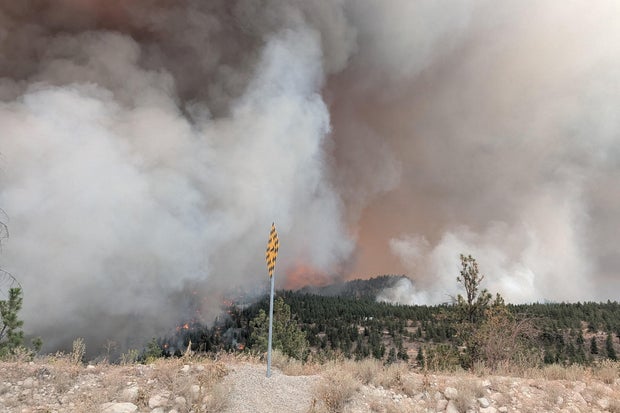
At an evacuation center in Penticton, Summerland resident Anette Boulet said the approaching fire “looked like doomsday.” She fled before dawn with her family and five dogs, unsure whether her home was still standing.
The speed of the fire forced even emergency officials to flee. Erick Thompson, an emergency official with the Regional District of Okanagan-Similkameen, said he had to abandon the emergency operations center and evacuate his family.
“I had to leave the EOC to come and get my family to leave this area. We’re heading south,” he said in a video posted early Saturday from his vehicle as traffic backed up around him.
Some residents were trapped as the fire advanced, Eby said, while search-and-rescue crews continued looking for others who may have been caught. British Columbia Forests Minister Ravi Parmar said 18 firefighting aircraft rescued more than 50 people.
“People have lost their homes. And many people have been displaced,” Eby said.
BC Wildfire Service/Handout via REUTERS 
The Bald Range wildfire, first reported Friday evening, raced roughly 9 miles toward Okanagan Lake within hours. By Sunday, the flames had scorched more than 53 square miles.
Anette Boulet was among residents who fled Summerland, home to about 12,000 people along Okanagan Lake. As she and her family left around 4:30 a.m. Saturday, their home was shrouded in smoke.
“You couldn’t see barely. It was, it was just dark, and the ridge, the ridge of fire just coming towards you,” said Boulet, who evacuated to a center in Penticton.
“There’s no words to express it,” she said. “The fear.”
Later Sunday, the Royal Canadian Mounted Police said an 80-year-old woman died while trying to escape the wildfire that forced evacuations in the Okanagan Lake region.
Besides the evacuations in Summerland, the Bald Range fire, has also led to the evacuation of about 8,000 people in and around nearby Peachland.
Eleanor Olszewski, Canada’s minister of emergency management and community resilience, said Sunday on social media that she’d approved a request for federal assistance from British Columbia to provide shelter and accommodations for those forced to flee.
A British Columbia Wildfire Service perimeter map showed the fire had burned through areas containing numerous homes north of Summerland and reached Okanagan Lake. Videos posted on social media appeared to show homes burning as residents fled along roads with flames on both sides.
Eby called the sudden growth “a remarkable escalation in fire activity” and said the blaze became so intense that it generated its own weather system and lightning.
Cliff Chapman, the British Columbia Wildfire Service’s director of operations, called conditions “explosive” and warned that other communities could face similarly fast-moving fires.
British Columbia Emergency Management Minister Kelly Greene said the state of emergency gives the province additional powers, including the ability to restrict travel and secure accommodations for evacuees that might otherwise be unavailable.
Highway 97, a major route through the region, was closed between Peachland and Penticton as roads filled with evacuees.
Canada has endured increasingly destructive wildfire seasons in recent years, forcing mass evacuations and repeatedly sending smoke across large parts of Canada and the United States. President Trump threatened Canada with additional tariffs in July after wildfires sent smoke into the New York City, Chicago, Detroit and Washington, D.C. areas, leading to severe air quality issues.
British Columbia experiences 1,600 wildfires per year, on average, according to the BC Wildfire Service.


