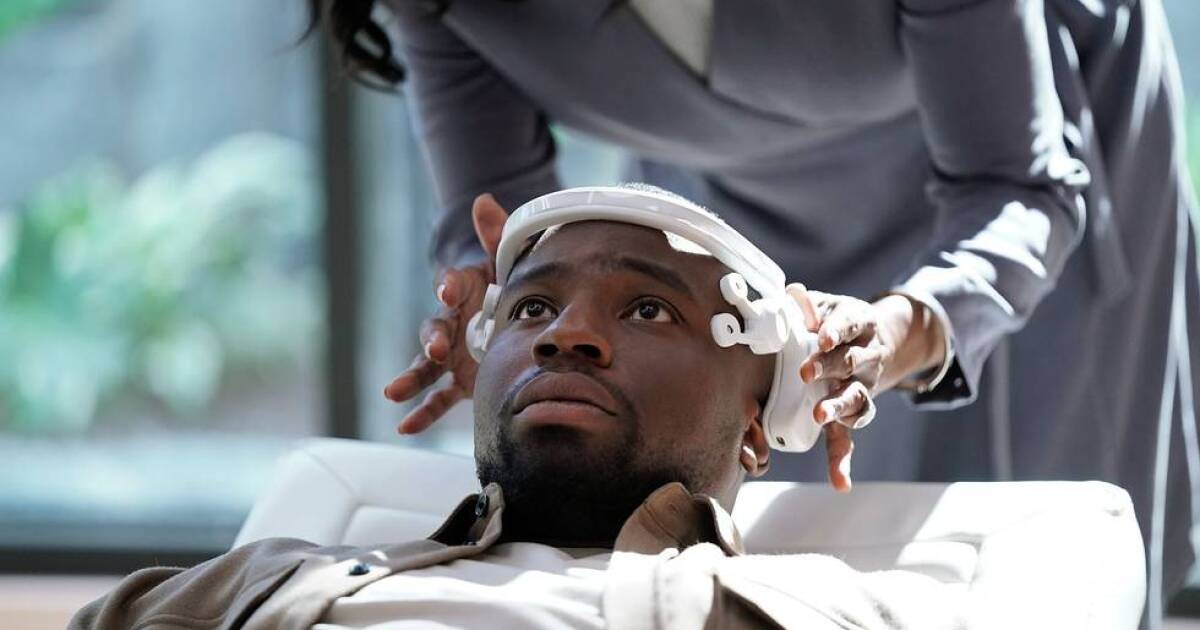
The road to “Demascus” — premiering Thursday on Tubi — runs through AMC, which had commissioned the series and then, though a six-episode season was completed, declined to air it. Not being privy to any boardroom discussions or the thoughts of executives and accountants, I won’t claim to know why that was — most everything these days is a calculation instead of a gamble. But simply as regards its quality, AMC was wrong and Tubi is right.
Created by playwright Tearrance Arvelle Chisholm (“Hooded: Or Being Black for Dummies”), it sits alongside some of the most interesting series of the last several years — comedies from Black creators that mess with form and time and space and reality — “I’m a Virgo,” “Government Cheese,” “The Vince Staples Show” and “Atlanta” and the cartoons “Lazor Wulf” and “Oh My God … Yes!” Perhaps if one already feels outside the system, there’s less temptation to play it safe. It’s not necessarily a recipe for success in the show-business terms, but it can produce good results.
Demascus (Okieriete Onaodowan), 33, is entering his “Jesus year, my year to be a martyr, and I’ve chosen this to be my martyrdom.” That martyrdom is therapy, he tells Dr. Bonnetville (Janet Hubert), as the series begins in a jungle — though this turns out to be a Holodeck projection. We’re in a version of 2023 — the year the series was first set to air — in which self-driving cars fill the road and a voice-activated assistant (here called Shekinah, played by Brie Eley) is everywhere, setting the stage for the series’ science-fictional central conceit.
“Nobody knows me. My one dominant quality is I’m unknowable,” Demascus tells her. “I can be anybody or nobody. … That’s a good quality for a Black man to have, right?” But does he know himself?
Bonnetville suggests that Demascus might be a candidate for DIRT (Digital Immersive Reality Therapy), an experimental psychological virtual alternate reality rig that “follows the path of your conscious and subconscious impulses, allowing you to visit alternate visions of yourself, but only as a voyeur. … Attempting to take control of a narrative can permanently corrupt your primary reality.” (Of course he will do just that.) But just what reality is primary is something the series purposely confuses and doesn’t quite settle or really needs to. The gizmo is an excuse for episodes and parts of episodes set in various contexts that work both as short stories and pieces of a bigger puzzle, and as a bonus allows the main cast to try on different roles — in repertory, if you will.
In what may or may not be his primary reality, Demascus is a graphic artist employed by the government — he’s working on a campaign to encourage Black participation in the space program — which makes for some office-based satire. He has a best friend, Redd (Caleb Eberhardt), a District of Columbia public defender, who will reappear in other forms (in one episode, “Thanksgiving,” they’re a couple); an uncle, Forty (Martin Lawrence), now dissolute, now respectable; and, in some scenarios, a sister, Shaena (Brittany Adebumola). He’s slowly losing interest in his “algorithmically compatible” girlfriend, Budhi (Sasha Hutchings), and becoming interested in Naomi (Shakira Ja’nai Paye), who appears variously as an artist, a nun and a nurse in a psychiatric ward. There’s a tentative pan-dimensional love story between them, the sort of thing that could easily be overdone, but is just … nice.
The series itself takes different forms — a relationship reality show, a “sad Thanksgiving” domestic comedy, a setting out of “One Flew Over the Cuckoo’s Nest.” Notwithstanding a change of hair or profession, Demascus remains more or less himself as shapes shift around him — the protagonist, basically a good guy, a little buttoned-up, a little insecure. He’s surrounded by more colorful, unpredictable characters, more acted upon than acting and dealing with the same issues from scenario to scenario. “There are rules and I know some of them and there are rules that I don’t know and they’re just ever-changing,” he tells Dr. Bonnetville.
According to press materials, the show explores the “gulf between Black male perspectives” and as with any culturally specific work, it may play to an audience that shares those specifics. But like all good art, it doesn’t limit its meanings to the artist’s statement. “Demascus” isn’t parochial or polemical; the emotional beats are accessible to any moderately sensitive human. And there’s pure pleasure to be found in the writing, which is sharp and smart and natural; the direction, which shapes and is shaped by the evolving material without getting in its way; and uniformly marvelous performances.
I finished the sixth episode, titled “Season Two Prequel” (following the penultimate episode, “Penultimate”), wanting more, though that possibility, given the series’ previous wandering in the wilderness, seems an open question. A line of dialogue hearkens back to the beginning in a way that might be thought of as closure, as a circle closes without going anywhere, and yet things are not the same. An ending you can take as a beginning, as with any fairy tale or romantic comedy, it’s a beautifully managed moment, as J. Cole’s “Love Yourz” — “No such thing as a life that’s better than yours” and “It’s beauty in the struggle” — makes its complementary points on the soundtrack.


