On the Shelf
Tonight in Jungleland: The Making of Born to Run
By Peter Ames Carlin
Doubleday: 256 pages, $30
If you buy books linked on our site, The Times may earn a commission from Bookshop.org, whose fees support independent bookstores.
Before “Born to Run,” Bruce Springsteen was in danger of being dropped by his record label.
But the landmark album, released 50 years ago this month, changed all that: The New Jersey native vaulted to stardom, becoming the first musician to appear on the cover of Time and Newsweek simultaneously.
In the absorbing “Tonight in Jungleland: The Making of Born to Run,” Peter Ames Carlin details Springsteen’s struggles to make the album. Leading up to its release, the musician had lost a champion at Columbia Records with the 1973 exit of president Clive Davis. This decreased support, coupled with poor sales and a lack of radio spins for his second LP, “The Wild, the Innocent and the E Street Shuffle,” later that year meant Springsteen’s future there was at risk.
Even stellar press reviews such as Jon Landau’s infamous 1974 critical assessment (“I saw rock ‘n’ roll future and its name is Bruce Springsteen”) didn’t necessarily help.
Musically, Springsteen was also getting used to musical shifts within his own band. Drummer Vini “Mad Dog” Lopez and keyboardist David Sancious had departed, with drummer Max Weinberg and pianist Roy Bittan filling their shoes.
For “Tonight in Jungleland,” Carlin drew on research and interviews, including a fresh conversation with Springsteen and others involved with the record, as well as archival chats conducted for his bestselling 2013 Springsteen biography “Bruce.” What emerges is a fascinating portrait of a talented, ambitious and stubborn young man with strong creative instincts — but who needed to get out of his own way to let the genius shine.
Here are five takeaways about the genesis and creation of “Born to Run” from “Tonight in Jungleland.”

Columbia Records didn’t see the potential in the album’s title track — at first.
Convincing Columbia Records to support his new work was a herculean struggle for Springsteen. Still, he had an ace up his sleeve: a song called “Born to Run” he had spent months refining.
Springsteen’s then-manager, Mike Appel, brought a tape of the song to play for Columbia exec Steve Popovich, an early believer in Springsteen’s music. The hope was that Popovich would love the song and convince the label’s head of A&R, Charles Koppelman, to support the single and Springsteen.
Popovich was busy juggling three separate phone calls (on three different phone lines, no less) but played the cassette anyway, absorbing the music while continuing his conversations.
Perhaps unsurprisingly, the listening session didn’t go as well as Appel hoped, with Popovich telling Appel: “I liked the riff. It’s all right, but I didn’t digest the rest.” Carlin quotes Appel responding: “Why don’t I digest some more myself? Like, we just finished it ourselves. And then we’ll come back to you with some other suggestions.”
But Springsteen’s then-manager ended up grabbing the label’s attention with guerrilla tactics: He leaked the single to radio stations who had supported Springsteen, drumming up buzz and airplay via DIY (and not-quite-legal) methods.
Jon Landau helped shape the album in pivotal ways.
Jon Landau, Springsteen’s manager and trusted confidant for decades, began collaborating with him during the “Born to Run” era, after Springsteen hired him to co-produce the LP.
“I don’t trust anybody, you know, but Jon and I struck up a relationship, and I said, ‘Well, this guy is theoretically going to be our producer,’” Springsteen told Carlin in 2024.
Landau suggested that the musician needed to record in a more professional recording studio, the Record Plant in New York City.
And he brought a keen editing eye to Springsteen’s songs, particularly “Wings for Wheels.” His advice to trim, cut and rearrange the music led to Springsteen revising the lyrics and emerging with “Thunder Road.”
“Suddenly we had a very different album,” Springsteen told Carlin. “We had a very different group sound, and we had streamlined ourselves into not a rock and soul band but into a tight little five-piece streamlined rock ‘n’ roll band.”
Springsteen’s perfectionist tendencies made finishing “Born to Run” a nail-biter.
A notorious perfectionist, Springsteen labored for months on the song “Born to Run.” He was even more fastidious about getting “Jungleland” right, which was a bigger issue: Springsteen had a strict deadline to finish the “Born to Run” album on July 20, 1975, as he was kicking off a tour that very night.
A few days before the LP was due, he switched up the end of “Jungleland,” adding more emphasis on the final line as well as anguished, wordless howls.
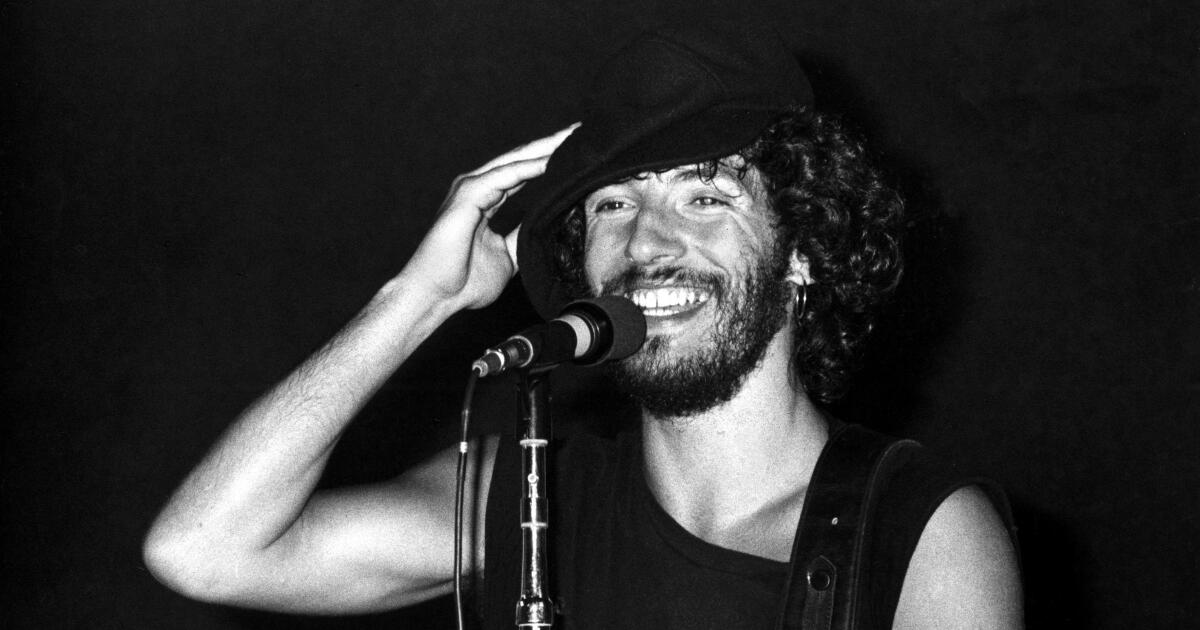
Peter Ames Carlin drew on fresh and archival interviews for his his book about Bruce Springsteen’s breakthrough album.
(Terry Allen)
He was even more painstaking about recording Clarence Clemons’ epic saxophone solo, staying up all night recording take after take alongside engineer Jimmy Iovine.
“Even after fifty years, the memory of what it took to record the sax solo to ‘Jungleland’ makes his eyes widen and his mouth drop open,” Carlin writes.
Springsteen initially didn’t like the finished album.
Carlin’s description of the moment Springsteen, his managers and the band listened to the final version of the seminal album is the most jaw-dropping passage of “Tonight in Jungleland.”
Carlin writes that he spoke to “at least ten different people” who were there at the session, and “no version of events holds from one voice to another.” But in the book, he recounts Springsteen critiquing the final song, “Jungleland,” and ending his remarks with: “I dunno, man, maybe we should just scrap it. Toss this s— and start over.”
Iovine then arrived with an acetate copy of the album from the master recording. This also didn’t go over well: After a listen, Springsteen threw the record into a hotel swimming pool.
Explaining his actions today, Springsteen told Carlin: “I just didn’t like it, you know. It was making me, you know, it just made me itchy on the inside and out.”
As indelible as the lyrics of “Born to Run” are, Springsteen shies away from talk of artistry.
Today, “Born to Run” is considered one of the greatest albums of all time.
The LP synthesized decades of popular music — soul, jazz, R&B, rock ‘n’ roll — to create a new musical language, while its depth-filled lyrics are a rich text full of allegories and religious imagery.
Surprisingly, Springsteen himself is unpretentious about his creation.
Carlin describes a long-ago encounter where then-road manager Stephen Appel (brother of Mike) told Springsteen he didn’t understand the lines, “The poets down here / Don’t write nothing at all / They just stand back and let it all be.” In Appel’s recollection, Springsteen responded, “That’s because I’m the poet.”
Decades later, Springsteen recalls things differently. “That doesn’t sound right,” he told Carlin. “In those days, I’m 24 years old, I’m really not that analytical, and I’m certainly not that self-analytical as of yet.
“I’m really just writing things and coming up with a line that feels good to me,” he continues. “Those lyrics were just instinctively written.”


