

Last year, when Joe Sullivan’s sugar beet fields were infected with a fungal disease called Cercospora leaf spot, he was devastated.
Sullivan, who farms throughout Renville County, said the disease cut his yields by about a third. He had to dig into his farm’s savings to cover the losses.
“It’s getting to the point of, it'll be interesting if we can keep growing the crops because they're very expensive crops to grow,” said Sullivan.
Cercospora leaf spot is a fungus that infects sugar beets. It damages their leaves, leaving spots on them.
“Then the plant goes, ‘Oh, I'm dying,’ and instead of taking its energy that it's storing in its root as sugar, it'll take that sugar and try pushing new leaves out,” said Sullivan.
That means infected beets have less sugar content than healthy beets, making them less valuable for farmers like Sullivan to sell them.
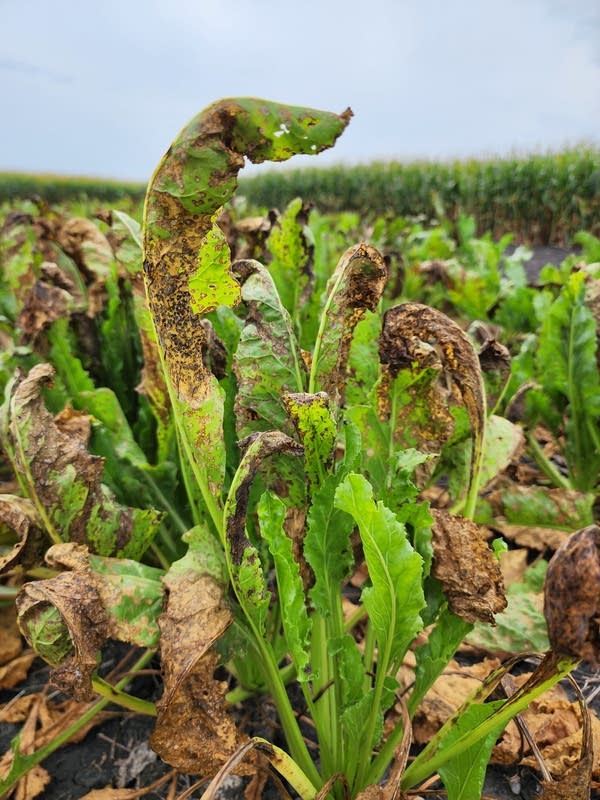
Ashok Chanda, an associate professor and extension sugar beet pathologist at the University of Minnesota, said weather patterns are changing.
More storms are coming to Minnesota, which, when combined with heat, create humid conditions in which Cercospora thrives.
Chanda added that the last two summers had the perfect conditions for both sugar beets and Cercospora alike to thrive.
“Historically, the years that we have higher disease are also really high yield for sugar beets,” said Chanda. “[Sugar beets] need temperature; they need moisture. The Cercospora thrives on the same conditions, so that's why you know when you have a huge crop, you have a huge risk for the disease as well.”
Chanda said so far, the growing season is coming along well. However, if the heat and rain persist in July, the fungus could return.
There are ways to prevent Cercospora from settling in. These include applying fungicides and increasing the crop rotation interval between sugar beets and cover crops.
However, there is no cure for Cercospora. Chanda said the goal is to actively manage the disease during the season.
Sullivan said USDA labs are now testing sugar beet fields in his area. He said he's resigned to the possibility that they will detect the disease.
“With the crop that we have, I'm sure we'll find spots by the first or second week of July,” said Sullivan. “If it doesn't stay as cool and not as humid, then it'll be better. But if you have hot and humid, it's just a matter of weeks that you're going to find some spots.”
However, should he detect the disease early enough, Sullivan said he’d be able to ramp up his prevention methods to slow down its spread.
“We have a great crop coming up; it’s just a matter of being proactive on our management,” said Sullivan.


