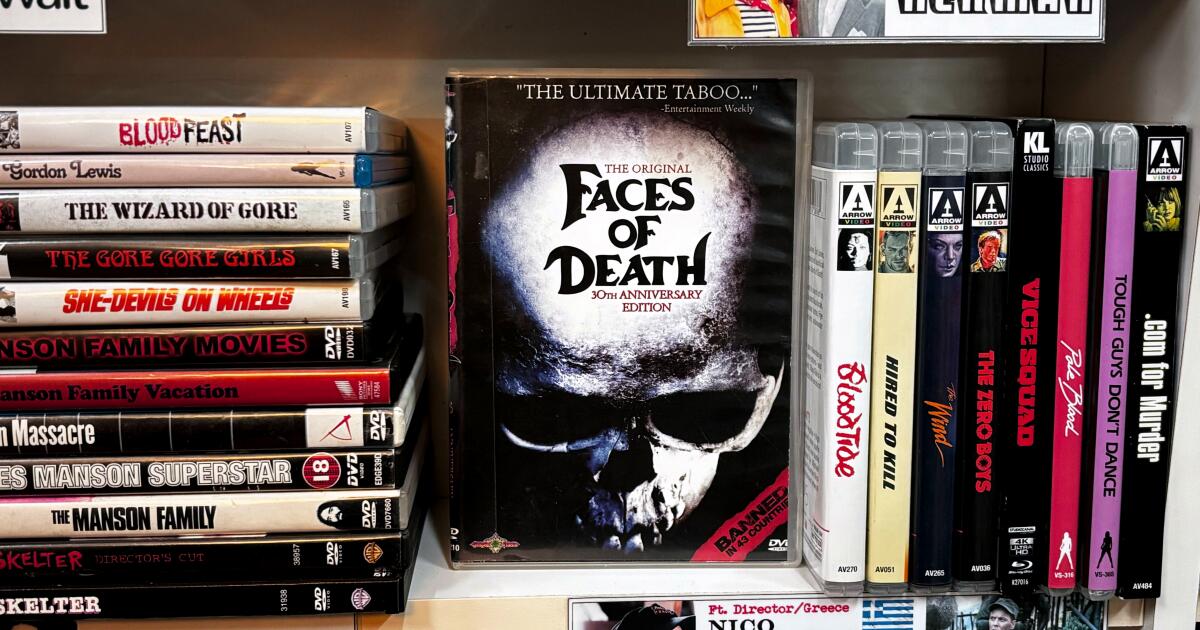
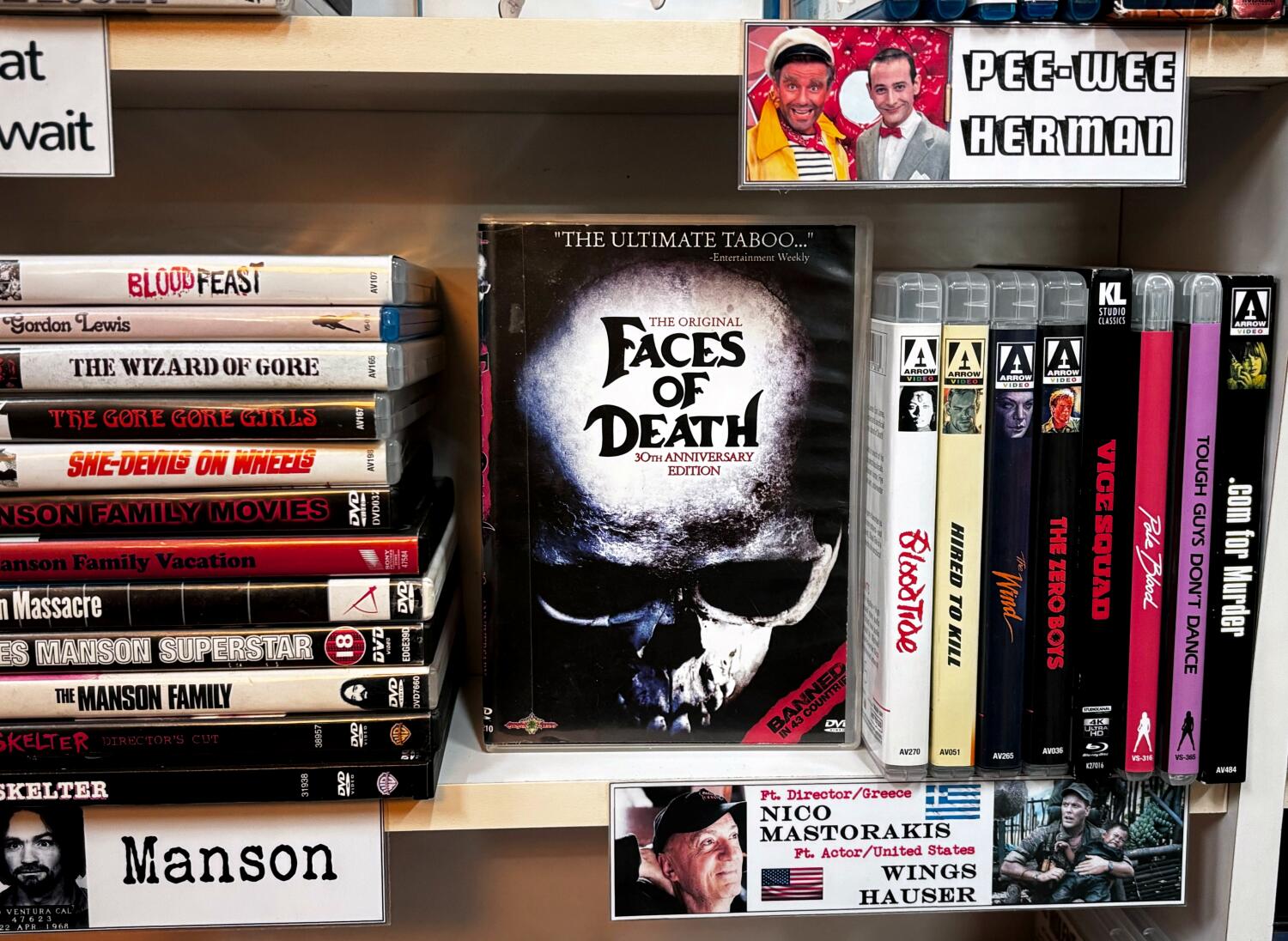
It’s been decades since “Faces of Death” stirred panic among parents of teens trading the 1978 pseudo-snuff VHS. The “video nasty” spawned a number of sequels, spinoffs and now a remake starring Barbie Ferreira and Dacre Montgomery that hit theaters this month.
But back in the 1980s, the original film caused an uproar at Southern California schools.
Days before school was out for summer in 1985, Escondido High School math teacher Bart Schwartz, then 28, used a spare two hours during finals week to squeeze in a film screening with his class. Schwartz wanted to show the film because it was “interesting.”
According to the Times coverage of the incident and subsequent lawsuit, the scenes shown in the classroom included autopsies, decaying cadavers and live animals being butchered, mutilated and tortured. The original “Faces of Death” also includes scenes of a man being electrocuted, a decapitation and an orgy during which a man is gutted by a flesh-eating cult.
Although today’s audiences might be more desensitized to such gruesome scenes thanks to hyperrealistic special effects in modern horror movies, and the commonplace spread of graphic clips online, audiences of the ‘80s were reportedly traumatized and scandalized. Not only was the film considered macabre, but it also was widely believed to be composed entirely of real footage.
“The ultimate taboo,” “100% real” and “banned in 46 countries!” were taglines for the original film. It wasn’t until decades after the film’s release that director John Alan Schwartz publicly confirmed that while some footage was real and pulled from news and autopsy archives, much of the movie was staged and the shockumentary’s host pathologist, Dr. Gröss, was an actor.
“Each new generation discovers it,” Schwartz told New York Public Radio in 2012. “And even though things look hokey now, there are still segments that people actually believe are real that aren’t.”
The 2026 remake, by comparison, is clear about its fictional plot, but also includes real clips of death that were “carefully trimmed,” according to director Daniel Goldhaber.
Back to 1985 — Escondido High’s Schwartz, who had previously been named “teacher of the year,” reportedly would not allow students to leave the classroom while the film played. One student, then 16-year-old Diane Feese, said the teacher fast-forwarded through the dialogue and forced students to watch the film’s most gruesome scenes. She covered her eyes, according to reports from the time, but was still subjected to other students’ commentary and the audio of the deaths depicted on-screen.
That fall — when school was back in session — Feese sued the teacher and the school principal for $3 million. Schwartz was suspended with pay for 30 days, then an additional 15 days without pay.
In 1986, another student in Schwartz’s math class, Sherry Forget, followed suit and took the math teacher to court for being subjected to the film. In 1987, the lawsuits were settled with Feese receiving $57,500 and Forget, who asked for $1 million, netting $42,500.
Less than a decade later, a Los Angeles high school teacher was also sued by his students for showing “Faces of Death.”
Verdugo Hills High School social sciences teacher Roger Haycock showed his cultural awareness class the film in December 1993. Students Jesse Smith and Darby Hughes alleged in their lawsuit that they were required to watch the film and write a paper on it. The teen boys said they suffered nightmares, emotional problems and were harassed by other students for their reaction to the film.
According to The Times, Haycock showed excerpts from “Faces of Death” to five classes that day and gave students the option to write a paper for extra credit or go to the library if they didn’t want to see the film. Haycock said he showed only parts of the film depicting animals being killed and did not show portions of the film that depict human death.
“Basically it had to do with the treatment of animals and the way we get our food, which was the lesson,” Haycock said at the time. “We go to the supermarket and get our meat, and we think it sanitizes us because it’s wrapped in plastic. But it has to be slaughtered for us by someone else. I was trying to show how other cultures provide food for themselves versus the way we do, living in the city.”
The judge dismissed the lawsuit, siding with the district’s argument that students shouldn’t be able to sue based on what they are taught in class.


