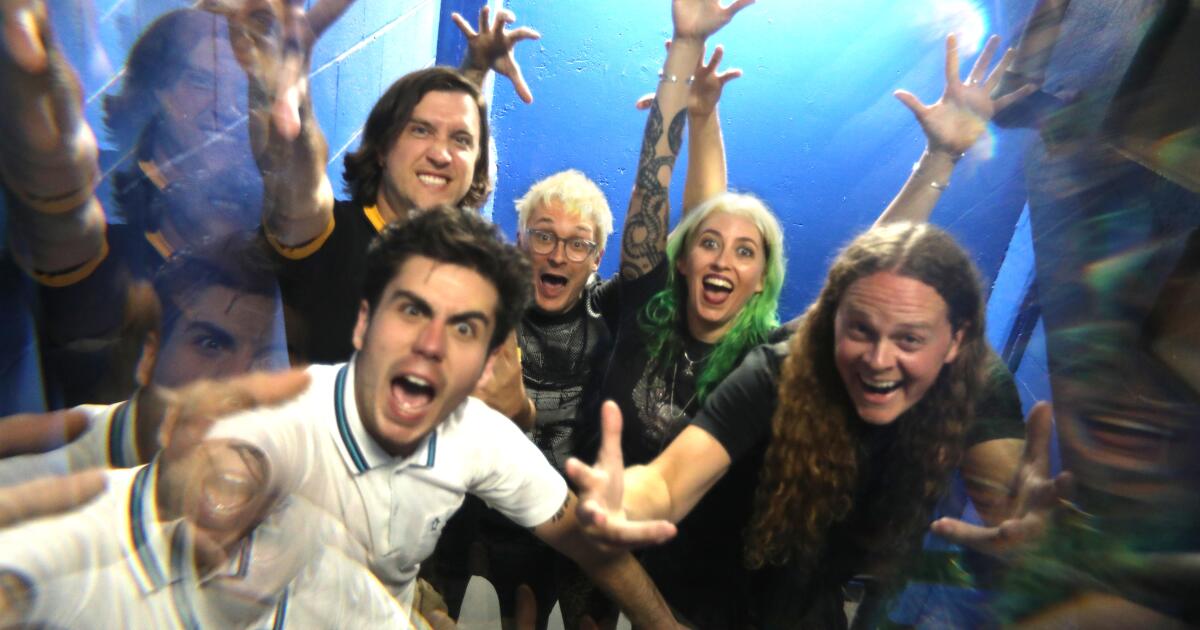
What do Dead Kennedys’ Jello Biafra, Thurston Moore of Sonic Youth and Motley Crüe bassist Nikki Sixx have in common? They all dig Frankie and the Witch Fingers, an L.A.-based band whose irresistible garagey-psychedelic rock sometimes even invokes shades of Oingo Boingo and Devo thanks to a staccato freneticism and pointed lyrics. The diversity of FATWF’s peer-fans speak to the quintet’s wide-ranging appeal, and the title of their new 11-song album, “Trash Classic,” is a spot-on descriptor of the LP as a whole.
In their longtime rehearsal-recording room in a legendary Vernon warehouse, the band perch on a couch a few days before leaving for tour. There’s a whiteboard with a set list behind the sofa, and they share some “mood board” phrases written for the creation of “Trash Classic.” On posterboard, the bon mots include “Lord Forgive Us For Our Synths,” “Jello -B.Y.O.F. (Bring Your Own Fork) – Ra” and “Weenus.” Laughter ensues at the memories.
The lineup formed with Dylan Sizemore (lead vocals, rhythm guitar) and Josh Menashe (lead guitar, backing vocals, synthesizer) more than a decade ago, the pair meeting at college in Bloomington, Ind. In different bands, they’d seen each other’s gigs and run into each other at parties.
“I was just bored one day, and was like, ‘I wonder if this guy wants to jam.’ I had all these songs,” recalls Sizemore. “I just kind of showed up to his house, and I knew he was really good at guitar and really good at music in general.”

Josh Menashe, from left, Dylan Sizemore, Nicole “Nikki Pickle” Smith, Jon Modaff and Nick Aguilar, of the Los Angeles psych-rock band Frankie and the Witch Fingers get into character in their rehearsal space in Vernon on July 11, 2025.
(Genaro Molina / Los Angeles Times)
The San Diego-raised Menashe recalls, “I think by the time I met Dylan, I’d already dropped out [of college], though, and there were day jobs — at a screen-printing shop, I worked at a Turkish restaurant; whatever I could do to keep my music addiction going. I never really settled on a major because I just couldn’t think about what I wanted to do. Nothing made as much sense as music.”
Sizemore had been dabbling in music that was “power-pop-y, kind of like Tom Petty worship …”
“… he was in a band called Dead Beach,” Menashe adds, “and I would say it was garage rock, almost like Nirvana meets Tom Petty.”
“And Josh was in a more like surf rock, almost like mathy band. What would you describe [the band] Women as?” Sizemore asks.
“Angular, punky, buncha noise stuff,” affirms Menashe, who also played with acclaimed Bloomington-to-L.A. band Triptides starting in 2010.
In FATWF (the name comes from Sizemore’s cat Frankie) the pair’s experience and influences were varied enough to create something new that, over seven albums since 2013, has morphed into a wildly creative and raucous band with hooks, melodies, smarts, irreverence, loud guitars and wonderfully oddball synth and sounds.
A move to L.A. in 2014 and eventual changes in the rhythm section — Nikki Pickles (Nicole Smith), formerly of Death Valley Girls, joining in 2019; with drummer Nick Aguilar’s 2022 addition solidifying the band further. Jon Modaff, a multi-instrumentalist from Kentucky who played drums on tour with FATWF in 2021, joined on synth in 2024, giving the band an even broader sonic palette to realize their sometimes-oddball audio dreams.
“Trash Classic,” produced by Maryam Qudus (Tune-Yards, Alanis Morissette, Kronos Quartet) follows 2023’s “Data Doom,” which was the first album to feature Aguilar on drums. Songs are by turns epic, edgy, spacey and insistent. Some “Trash Classic” lyrics are topical and pointed: “(While the upper) class is feeding / (On the lower) babies’ food / (Microwaving) TV dinners / (With the porno) graphic news.” “Economy” minces no words: “This has got to be / The best economy / The plasma you sell / (The plasma you sell) / Buys money to eat.”

There was no grand plan or lyrical theme settled ahead of the new album’s creation. “We collectively talk about what’s going on in the world when we’re in rehearsal and stuff, and our feelings about it,” says Sizemore. “I think it’s just at a point now where talking about certain things just feels more — what’s the word? — it feels more part of the zeitgeist. Like ‘Economy,’ I wanted to write about being around abject poverty. But it makes more sense now, it fits into the context of where we are. Things that we talk about in here, about what’s going on, maybe weren’t so omnipresent, and now it feels like it is. Like, you can’t escape poverty. You can’t escape what’s happening to people less fortunate than you. It’s everywhere.”
In writing the lyrics, Sizemore thought about growing up, “seeing people trade in their food stamps to get alcohol because they’re addicted. Messy stuff like that. But it’s relevant now, it’s not just parts of the world. It’s gonna be everywhere if we don’t do something about it.”
Lyrics, while Sizemore-centric, are a collaborative process. Pickle, however, who came to bass in her 20s, says, “I just am happy to be along for the ride, and I’ll contribute where it’s helpful. I like to sit back; I guess I don’t feel qualified as a songwriter.” But, she says, “honestly, I think that that’s a helpful way to be, because if you have too many people with egos on top of each other, like, ‘no, no, no, do it my way.’ I like to listen and then insert where I can. That’s my vibe.”
Differing approaches and backgrounds serve FATWF well. Because of their “cohesive diversity and flexibility in the rock realm,” Aguilar observes, “I feel like we could play with almost anybody. At least a rock band, to any extent.”
While they’re mostly doing headlining tours, they’ve shared stages with Cheap Trick and ZZ Top. So where would FATWF overlap with the two elder statesmen classic rock lineups on the musical spectrum?
“I mean, we were really into the [13th Floor] Elevators, and…” Sizemore says.
“The Velvet Underground…” adds Pickle.
“…Roky Erickson, all that stuff. I think we tried to, like, gear our set more in that direction, just so we weren’t fully playing freaky, noisy funk stuff,” Sizemore continues. “But there’s an overlap, for sure. If we play in Atlanta or something, we’ll get someone saying, ‘Oh, the first time I saw you guys was with ZZ Top’ and that’s always cool.”

“We collectively talk about what’s going on in the world when we’re in rehearsal and stuff, and our feelings about it,” says Sizemore. “I think it’s just at a point now where talking about certain things just feels more — what’s the word? — it feels more part of the zeitgeist.”
(Genaro Molina / Los Angeles Times)
Most of Frankie’s members cite the DIY scenes in their areas as influential: Aguilar is from San Pedro and began drumming at the age of 10. He eventually played with that neighborhood’s most famous musician: bassist Mike Watt, and growing up, “discovered I don’t need to go to the Staples Center or Irvine Meadows to see a band. I could just go, like, 10 blocks away from my home on my bike to house shows,” he says, adding, “if there wasn’t the music scene in San Pedro, I probably wouldn’t be in this band. I’d probably be playing at the Whisky with some s— metal band that nobody cares about.”
An increasing number of people are caring about FATWF; Jello Biafra even joining them on stage. At a gig in Biafra’s hometown of Boulder, Colo., the punk provocateur met the band after their show. The next night, the singer showed up in Fort Collins.
“We have a lot of mutual friends,” explains Aguilar. “I work at Alex’s Bar in Long Beach. So I met him there a long time ago. He said he was gonna come see us at our Halloween show in San Francisco. I was like, ‘How would you feel if we learned some DK songs and you sang with us for Halloween?’”
He answered in the affirmative, so Frankie and the Witch Fingers learned the Dead Kennedys’ “Halloween,” “Police Truck” and “Holiday in Cambodia.” Biafra rehearsed with the band at sound check, and for the holiday show FATWF dressed up as “bloody doctors.” As for Biafra? “He changed his outfit in between every song! He was throwing fake bloody organs at the audience. You could tell half of the audience knew who he was. And half was like, ‘Yo, who the hell is this?’”
“Talking about all this like ancient history makes me feel, ‘Oh yeah, we’ve kind of come a long way,’” Pickles ruminates. Aguilar states his somewhat modest hopes for the band: “I think my realistic goal is the headline the Fonda Theater one day.”
But if larger-scale fame and fortune find Frankie and the Witch Fingers, beware: Menashe claims he’d get a face tattoo if the band sells a million records. His promise is captured by the reporter’s recorder, officially “on the record,” the band teases him. But in true FATWF fashion, Sizemore pushes it one further: “You gotta get a teardrop too!”


